


Page 132 - JavaScript
P. 132
function newUnicorn() {
           return fetch('unicorn.json')                     // fetch unicorn.json from server
           .then(responseCurrent => responseCurrent.json()) // parse the response as JSON
           .then(unicorn =>
             fetch('new/unicorn', {                         // send a request to 'new/unicorn'
                 method: 'post',                            // using the POST method
                 body: JSON.stringify({unicorn})            // pass the unicorn to the request body
             })
           )
           .then(responseNew => responseNew.json())
           .then(json => json.success)                      // return success property of response
           .catch(err => console.log('Error creating unicorn:', err));
          }


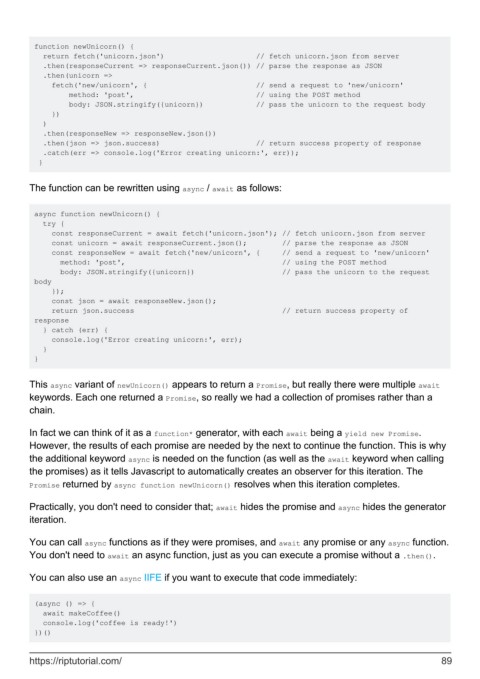
        The function can be rewritten using async / await as follows:


         async function newUnicorn() {
           try {
             const responseCurrent = await fetch('unicorn.json'); // fetch unicorn.json from server
             const unicorn = await responseCurrent.json();        // parse the response as JSON
             const responseNew = await fetch('new/unicorn', {     // send a request to 'new/unicorn'
               method: 'post',                                    // using the POST method
               body: JSON.stringify({unicorn})                    // pass the unicorn to the request
         body
             });
             const json = await responseNew.json();
             return json.success                                  // return success property of
         response
           } catch (err) {
             console.log('Error creating unicorn:', err);
           }
         }


        This async variant of newUnicorn() appears to return a Promise, but really there were multiple await
        keywords. Each one returned a Promise, so really we had a collection of promises rather than a
        chain.

        In fact we can think of it as a function* generator, with each await being a yield new Promise.
        However, the results of each promise are needed by the next to continue the function. This is why
        the additional keyword async is needed on the function (as well as the await keyword when calling
        the promises) as it tells Javascript to automatically creates an observer for this iteration. The
        Promise returned by async function newUnicorn() resolves when this iteration completes.


        Practically, you don't need to consider that; await hides the promise and async hides the generator
        iteration.


        You can call async functions as if they were promises, and await any promise or any async function.
        You don't need to await an async function, just as you can execute a promise without a .then().

        You can also use an async IIFE if you want to execute that code immediately:


         (async () => {
           await makeCoffee()
           console.log('coffee is ready!')
         })()


        https://riptutorial.com/                                                                               89

