


Page 193 - JavaScript
P. 193
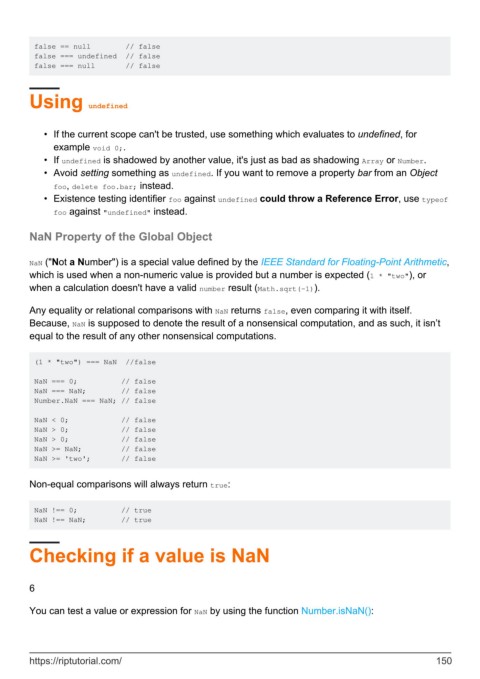
false == null        // false
         false === undefined  // false
         false === null       // false


        Using undefined


            •  If the current scope can't be trusted, use something which evaluates to undefined, for
              example void 0;.
            •  If undefined is shadowed by another value, it's just as bad as shadowing Array or Number.
            •  Avoid setting something as undefined. If you want to remove a property bar from an Object
              foo, delete foo.bar; instead.
            •  Existence testing identifier foo against undefined could throw a Reference Error, use typeof
              foo against "undefined" instead.


        NaN Property of the Global Object


        NaN ("Not a Number") is a special value defined by the IEEE Standard for Floating-Point Arithmetic,
        which is used when a non-numeric value is provided but a number is expected (1 * "two"), or
        when a calculation doesn't have a valid number result (Math.sqrt(-1)).


        Any equality or relational comparisons with NaN returns false, even comparing it with itself.
        Because, NaN is supposed to denote the result of a nonsensical computation, and as such, it isn’t
        equal to the result of any other nonsensical computations.


         (1 * "two") === NaN  //false

         NaN === 0;          // false
         NaN === NaN;        // false
         Number.NaN === NaN; // false

         NaN < 0;            // false
         NaN > 0;            // false
         NaN > 0;            // false
         NaN >= NaN;         // false
         NaN >= 'two';       // false


        Non-equal comparisons will always return true:


         NaN !== 0;          // true
         NaN !== NaN;        // true


        Checking if a value is NaN


        6

        You can test a value or expression for NaN by using the function Number.isNaN():


        https://riptutorial.com/                                                                             150

