


Page 68 - JavaScript
P. 68
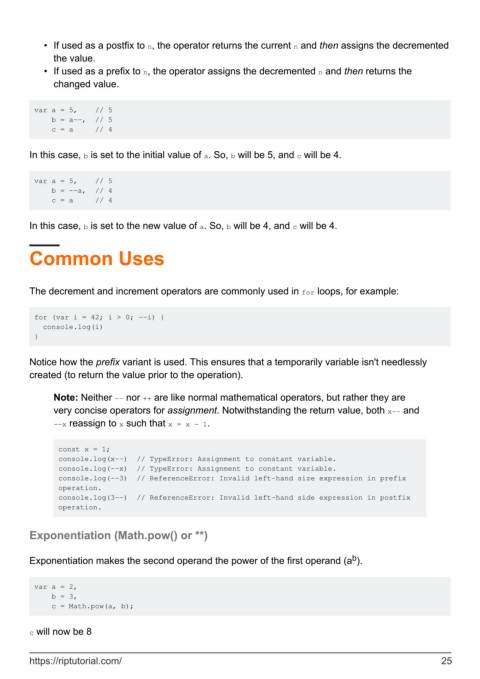
•  If used as a postfix to n, the operator returns the current n and then assigns the decremented
              the value.
            •  If used as a prefix to n, the operator assigns the decremented n and then returns the
              changed value.


         var a = 5,    // 5
             b = a--,  // 5
             c = a     // 4


        In this case, b is set to the initial value of a. So, b will be 5, and c will be 4.


         var a = 5,    // 5
             b = --a,  // 4
             c = a     // 4


        In this case, b is set to the new value of a. So, b will be 4, and c will be 4.


        Common Uses


        The decrement and increment operators are commonly used in for loops, for example:


         for (var i = 42; i > 0; --i) {
           console.log(i)
         }


        Notice how the prefix variant is used. This ensures that a temporarily variable isn't needlessly
        created (to return the value prior to the operation).

              Note: Neither -- nor ++ are like normal mathematical operators, but rather they are
              very concise operators for assignment. Notwithstanding the return value, both x-- and
              --x reassign to x such that x = x - 1.


               const x = 1;
               console.log(x--)  // TypeError: Assignment to constant variable.
               console.log(--x)  // TypeError: Assignment to constant variable.
               console.log(--3)  // ReferenceError: Invalid left-hand size expression in prefix
               operation.
               console.log(3--)  // ReferenceError: Invalid left-hand side expression in postfix
               operation.


        Exponentiation (Math.pow() or **)


                                                                                        b
        Exponentiation makes the second operand the power of the first operand (a ).

         var a = 2,
             b = 3,
             c = Math.pow(a, b);


        c will now be 8


        https://riptutorial.com/                                                                               25

